View from Riverfront Park
News and views about real estate in Greater Hartford

Archive for the 'Market Statistics' Category

An Economist’s View of the National Housing Market

Economists are divided as to the direction of the national housing market. Some believe that the environment is stabilizing and that prices will increase from here. Others see further price decreases once the government support fades away.

Richardson Building in Downtown Hartford

Barry Ritholz is one economist we follow regularly, through his posts on The Big Picture blog. Right now, he has a strong negative view on the future of the US housing markets. One of yesterday’s posts broke down his views in more detail.

Looking back at how we got to where we are today, Mr. Ritholz notes that that low interest rates throughout the 2000s caused a credit bubble, which in turn caused a housing boom. Lots of people bought houses they couldn’t afford because poor lending standards and very low mortgage rates allowed them to jump into the real estate markets. Five million homeowners have been foreclosed upon, and he expects five million more foreclosures to come.

His forward-looking thesis is that even after a 33% fall from the peak, prices are still too high when looking at traditional valuation metrics like prices vs income and the cost of owning vs renting. Supply is high, with more waiting in the wings. Demand is well below the inflated peak levels, caused by tighter credit and high unemployment. And when markets correct from severe imbalances, they usually move well below the mean.

How does his thesis translate to Greater Hartford?

Our markets did not appreciate nearly as much as markets in some other parts of the country, which has also meant that we have not seen as severe a correction. However, housing in the northeast is generally more expensive than it is/was in the boom areas, so there is more room to fall. And there is no guarantee it will always be more expensive up here.

Inventory: Real estate inventories in Hartford County checked in at just over 6 months of sales activity at the end of the first quarter. That’s right on the boundary between a neutral market and one that favors buyers, so we’re not seeing any major warning signs here. The number at the end of the second quarter should be comparable, or even better, since the tax credit created a huge spike in deals that will close by the end of June.

Foreclosures: The number of foreclosures has increased dramatically in the past few years. A recent Hartford Courant article focusing on the amount of money marshals earn indicates that “five or six years ago there were 3,000 or 4,000 foreclosures” per year in the state. Compare that to a statistic later in the article stating that 20,000 foreclosures were filed in 2009, which was 40% more than 2008.

Employment: The employment situation in Greater Hartford has improved over the past year. People we talk with say that companies are adding employees, though many positions remain unfilled and may never be filled. We are also seeing more relocation buyers coming from out of town, which of course means that they have jobs waiting for them. That’s the short-term view. The long-term view is more negative. One of our major employers has gone on the record saying that they want to move jobs anywhere outside of Connecticut. The comment made headlines, but nobody seemed especially surprised by the news. The housing market depends on buyers with steady income, which depends on employment.

Credit and Mortgage Rates: Buyers with good credit are able to get mortgages, and are currently seeing very low rates. However, buyers with poor credit are having trouble financing a purchase and often have to sit out of the market for a year or two to repair their credit. We know of numerous buyers in this situation – all of whom are gainfully employed.

Overall, the environment in Greater Hartford is trending in the same direction as the national picture for three out of four areas that Mr. Ritholz identifies as concerns. It’s difficult to know how severe our readings are relative to the national average, but it seems like we may be at risk for falling prices if his analysis turns out to be correct.

Who Pays the Most Taxes in Hartford County?

So who pays the most taxes in Greater Hartford? It’s not as easy to figure out as it might seem. All the talk of revaluations, budgets, and referendums got us thinking about how we could get at that question using the real estate data in the MLS.

We decided to look at all the single family home sales in Hartford County that were input using the Grand List 2009 mill rates. The initial data set had just over 4,000 closed MLS transactions (deemed reliable but not guaranteed) with listing dates between July 1, 2009 and June 19, 2010, which should have been input using the Grand List 2009 mill rates. After eliminating deals with missing data, we ended up with just over 3,800 data points spread across 29 towns.

Next we did some simple calculations and took the median values for everything. Ideally all of this data would have been published in a sortable table embedded in the post, but we couldn’t get it to work right (feel free to send tips or hints). Instead you’re getting the same large table sorted in different ways … our apologies in advance.


The first sort is based on the dollar amount of taxes paid – who wrote the largest checks?

All values are medians
Tax Bills for Hartford County Grand List 2009

Residents of the more expensive towns wrote the largest checks. Since the values of their homes are the highest, the tax bill – even at a lower tax rate – will he higher.


What if adjust for the home prices? Who pays the highest percentage of their home’s value as taxes each year?

All values are medians
Taxes as a Percent of Value for Hartford County in Grand List 2009

With this adjustment, some towns with low median sales prices have moved to the top of the list, though some of the higher median sales price towns are also paying more than 2% of their home’s value in taxes each year.


Finally, we could adjust for home size to see who pays the most taxes per square foot of house…

All values are medians
Taxes per Square Foot in Hartford County for Grand List 2009

This time we see towns with smaller homes and higher median sales prices leading the pack. The results should be very similar to a sales price per square foot calculation. People end up paying the highest taxes per square foot in towns where they also pay the highest purchase prices per square foot.

These results show a slightly different result that simply looking at the mill rates, though the mill rates are helpful as a quick first estimate. Farmington has some of the lowest taxes of the towns with high median sales prices, while Windsor Locks is the least taxed town with low median sales prices.

Real Estate Activity Decrease by Town – May 2010

May is a busy real estate month. More deals are done in the spring than in other times of the year, and the month of May is right there in the middle of the spring. In most years, the months of April and May have the two highest totals of contracts written (buyers and sellers agreeing on a sale). May usually edges out April, but not always. It depends on how the holidays fall, and whether there are other major events that distract buyers from the real estate market.

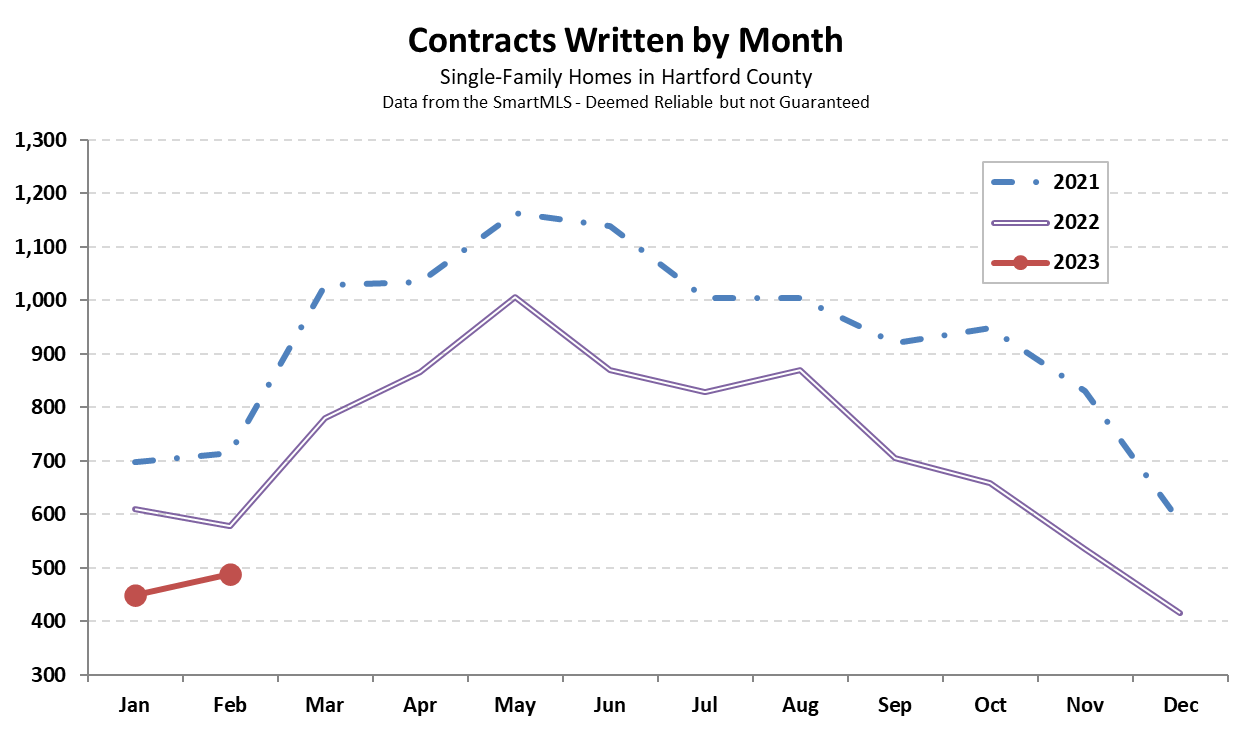
The chart below shows the contracts written by month for single-family homes in Hartford County. Data is shown for all of 2004 and the first five months of 2010. All data comes from the Connecticut Multiple Listing Service, and is considered reliable, but not guaranteed.

Hartford County Contracts Written by Month

May didn’t win this year, which isn’t much of a surprise. Everyone already knows why … tax credit. Nuff said.

But how about the individual towns? Did all of them show the same fall-off in activity? Did the tax credit matter more in some towns than in other towns?

Contracts Written by Town in Spring 2010This table shows the number of single-family home contracts written for each town in Hartford County. The percent change in the market activity between May and April is shown in the final column, and is used to sort the table.

There is a huge range of results; from apparently no impact in Burlington all the way down to a 75% decrease in activity in Canton, East Windsor, and Wethersfield. Scanning through the percent difference column, it’s interesting that there are towns throughout the whole range – they are not bunched together.

The results also don’t seem to follow median sales prices. Of the more expensive markets, Farmington, Simsbury, and Glastonbury showed smaller declines than most towns, but Avon had one of the largest. Of the less expensive markets, Bristol, Hartford, East Hartford, and New Britain were pretty evenly distributed throughout the middle of the range.

Despite the broad decrease in activity, buyers and sellers are still out there looking for homes. Buyers may have more of an advantage because there is less activity, but not in all cases. Desirable properties continue to sell with multiple offers if they are priced appropriately – just last week we had listing and buyer clients participate in multiple offer situations.

What’s your take based on your search or sale?

« Previous Entries

Next Entries »