Archive for the 'Mortgages' Category
Refinancing Our House- Journey Underway
Last week I wrote a post about trying to refinance our house. We’re well underway at this point and hope to close in the next 45 days or so, as long as everything goes as planned.
All four lenders that I initially called responded quickly to the voicemails I left them. Three were brokers that have several banks available to them and one was a local credit union.
They all said that they’re getting lots of refinance calls these days. I indicated that we would be interested in refinancing from a 30-year fixed rate mortgage to a 15-year fixed rate mortgage, we had enough equity in our house to refi and our credit scores were strong. The main unknown for us would be income requirements because we are both self employed and lending requirements have changed regarding the required documentation for self employed individuals.
All of the lenders I spoke with indicated that we should have no problem moving forward with a refinance, even with our self employment status. Our income history was strong enough, we would just need to submit more documentation (full tax returns, income statement and balance sheets) than a traditionally employed person. You know, people that work for The Man.
Some would be able to have the process done in as quickly as 4 weeks, while others indicated they were closing 60 days out now because of such a backlog with the paperwork processing of all the files they were closing. We weren’t too concerned about closing in 30 versus 60 days, just as long as we could lock our interest rate.
Surprisingly, all of the lenders had almost identical estimates for closing costs. None would be charging us points. Some could lock us right away, while others had to wait until the appraisal was done. We ended up going with a lender that gave us a 60-day rate lock and the lowest rate.
Three of the lenders quoted us a rate of 3.875%. The rate we ended up locking at? 3.75%. Whoo hoo! Better than our little financial models we concocted were using. So our overall savings on interest would be an additional $2,500 lower than what we budgeted. A grand total of $112,500 that we won’t have to pay some stinky bank. Double whoo hoo!
What’s happening at this point is reams and reams of paperwork. Lot of documents for us to read through and sign. Also lots of financial documents from us to scan and upload to the lender’s system. Next week is our appraisal. There’s actually plenty of data in our neighborhood for the appraiser to use. I have a value in my head for our house which I think is pretty conservative. We’ll see if they meet or exceed it. However, they’re apparently coming from New Haven, which makes me think that they don’t know Hartford all that well, so we’ll see what they come up with. We’ll let you know how that goes next week and I’ll talk more about the appraisal process then.
Refinancing Our House
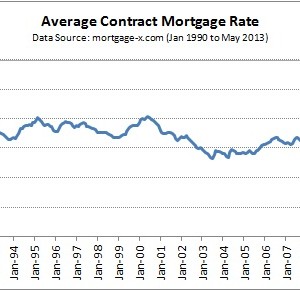
The other day Kyle wrote a post about how low mortgage rates are right now. We’ve been kicking around the idea of refinancing for a while, and at this point think we’d like to move forward. This is an opportunity to lower our rate significantly.
The big questions:
1. Is it worth it – how much of an impact will a lower rates have? For us, the attraction is paying less interest over the life of the loan. We’re going to be trying to refi into a 15-year mortgage, with rates at right about 3.875% right now, which will actually increase our monthly payment by about $300 a month, but reduce the overall interest we pay over time by $110,000. (Holy crap!) We’ll knock 10 years off our current (remaining) mortgage. The principal portion of our monthly payment will be almost 3x greater than in our current mortgage.
2. Do we have enough equity in the house? Home prices have dropped in our neighborhood since we purchased, but our down payment and upgrades should make the appraisal on our home high enough to refinance without being forced to bring extra principal to closing.
3. Does this overcome the up-front investment in closing costs? Unfortunately, refinancing a mortgage has meaningful closing costs that will not be recovered. For example, we’ll need to hire an attorney, pay for an appraisal, buy title insurance, and pay the lender, among other things. We think the answer is yes, it does make sense to invest a couple thousand in closing costs now to reap the benefits over the coming 15 years (we don’t plan on moving).
4. Will a bank lend to us? We hope so! But I guess we’ll find out soon.
One of the main reasons we’ve decided to refinance is the lack of good investment options. Money market accounts pay basically nothing. Stocks are no longer the comfortable long-term bet they were during much of last century. Bond yields are very low, so interest rates are low. This also means bond prices are very high – they’re much more likely to fall in value than rise. Where should we be investing?
Rather than choose between those unattractive options, we’re going to take this opportunity to improve our debt situation. By paying 3.875% instead of 5.375% it’s like we’re “earning” 1.5% on the entire mortgage principal balance. Our investment in closing costs should break even after about 12 months.
Since we’re in real estate, we know a lot of lenders. I’ve started this morning off by calling 3 of them. We’ll see how the process goes and keep you updated on our progress and any bumps in the road. We figure lots of folks are contemplating this right now, or going through it themselves, so we might as well share our experience so others can learn from it. Wish us luck!
Vultures as Angels
There was an interesting article in last week’s Wall Street Journal about the success a hedge fund is having in modifying mortgages and keeping homeowners in their homes. The point of the article was to highlight a successful private market example of mortgage modifications, in this case a distressed investment fund, as compared to the highly publicized Federal programs like the Home Affordable Modification Program (HAMP).
A key difference between the hedge fund’s strategy and HAMP seems to be the willingness to reduce the principal owed on the loans. The hedge fund forgives a portion of the principal in 90% of their modifications. Federally regulated banks subject to HAMP, according to the article, are more likely to lower interest rates, give homeowners time to catch up on late payments, and extend the length of the loan. They only forgive a portion of the principal in 2% of their modifications.
Despite the strong case that the article makes for the private market strategy over government involvement, it identifies two critical factors that limit the hedge fund’s effectiveness:
1. Many mortgages have thousands of owners. Because mortgages were packaged into securities for resale, the infamous Residential Mortgage Backed Securities (RMBS) that were part of the credit crisis, it is often impossible to buy (and therefore modify) individual mortgages – they have thousands of owners.
2. Banks don’t want to recognize losses. If a mortgage does have a single owner, like a bank, then that owner has to be willing to sell the loan at a steep discount in order for it to be attractive to the hedge fund. After all, they’re doing this to make money. The strategy banks currently employ of lowering rates and extending the term allows them to push any losses into the future.
In the end there is no suggested way forward, though presumably the author would hold up the private market model as the ideal. Reports from the government itself seem to show that the Federal programs are not working for everyone either. For many homeowners, the end result is likely to be foreclosure unless the economy and housing markets bounce back quickly.
Check out the full article for an interesting story, and by all accounts a successful mortgage modification strategy for certain homeowners.