Archive for the 'Think Big' Category
More on Demographics and Real Estate
Below is another article about demographics and other real estate trends that builds on the research of Arthur C. Nelson. It came to my attention after being posted by City of Hartford COO David Panagore. This continues on the themes of Mr. Condon’s piece from Sunday and our take on specific neighborhoods that may benefit from the market shifts.
I’ll be honest, I couldn’t get through the whole thing in the first sitting, but when I finally did, it seemed worth the effort.
The Next Real Estate Boom: How Housing (Yes, Housing) Can Turn the Economy Around
Patrick C. Doherty and Christopher B. Leinberger
Washington Monthly, November/December 2010
Boomers Boomerang Back into Town
This Sunday’s Hartford Courant had an interesting piece by Tom Condon titled “Subdivisions On Way Out?” It is definitely worth a read if you were focused on other things yesterday, like spending time with your mother or enjoying the beautiful weather.
The basic thesis is that a confluence of trends will lead to more large houses for sale in the suburbs than buyers who will be interested in purchasing them. Supply will come from the Baby Boomer generation downsizing to smaller, lower-maintenance housing options.
However, demand for their properties may not materialize. Household size is increasing as multiple generations of a family are more frequently living together. Financially marginal buyers struggle to get a mortgage in the current environment, preventing them from being homeowners. Factors like smaller home sizes, walkable neighborhoods, mixed-use environments, and shorter commutes are creeping up to the top of buyer wish lists.
Many interesting questions could be asked using this thesis as the set-up. The first one that jumps to my mind is this, which areas of Greater Hartford will benefit most from these trends?
Some of the winners are obvious. West Hartford Center offers exactly the mix of features that Mr. Condon describes. It is an established mixed-use community with smaller homes, in a walkable setting, that is convenient to just about everything in the region. Slam dunk. The Center is currently one of the hottest real estate markets in the area with basically no inventory available. If you want to buy there, then you need to have your act together.
Other areas seem like logical winners, but there is still considerable work to be done. I see Downtown Hartford as a long-term winner. Right now there is a core group of residents excited about Downtown as a neighborhood. Seven recent apartment developments (The Hollander, The Metropolitan, The Lofts at Temple & Main, 915 Main, Bushnell on the Park, 55 on the Park, and Hartford 21) are generally considered successes. Active planning is underway to rehab another building, the former hotel on Constitution Plaza. There are many additional opportunities to add residents in smaller, apartment-style, homes that are in a mixed-use community with major established businesses and legitimate public transit.
Really, the whole Farmington Avenue corridor from Downtown Hartford through West Hartford Center seems like it has a chance to win big in the coming decades. Asylum Hill and the West End have a lot to offer on the Hartford side of the line. Residential density continues on the West Hartford side of Prospect Avenue with numerous apartment buildings and commercial areas transitioning to single-family housing just off the main road.
In the real estate market, we are already seeing buyers from the Farmington Valley come over the mountain to look at our listings in the Elizabeth Park neighborhood of West Hartford and in Hartford’s West End. If Mr. Condon is right, then this could be the beginning of a trend that will play out for years to come.
Mortgage Terms Moving Against Buyers
Interest rates and down payment amounts are both trending upwards, according to recent articles on the current state of home mortgages, potentially reducing the purchasing power of buyers.
After bottoming out around 4.25% last fall, mortgage rates for 30-year fixed-rate loans have recently moved above 5% for the first time in about a year. Commentators observe that rising rates will cause some buyers to rethink the advantages of home ownership, but generally conclude that they are not a critical threat to the housing market.
The Wall Street Journal and Zillow reported that median down payments for “conventional” mortgages rose from about 5% at the end of 2006 to 20% in 2008 in a study of 9 cities. The article also notes that mortgages backed by the Federal Housing Administration (FHA), requiring only 3.5% down payments, have increased in popularity and were used in about half the purchases in 2010.
It seems to us that there are two separate things going on here. The first is related to the overall economy and the financial policies of the country. Mortgage rates are based on the yields of the 10-year Treasury Bond. If the creditors of the United States are demanding a higher interest rate, then those higher rates will trickle down to mortgages.
The second factor influencing mortgage terms is the continued evolution of the American mortgage industry. Lenders have taken a lot of losses from their loan portfolios over the past 5 years. Not surprisingly, they’re trying to improve their business practices to make these sorts of situations less likely in the future. What mortgage products should be available? What should lenders require of buyers? What makes a borrower creditworthy? What role will the government play?
We have no special insight into either of these two issues, or the direction of mortgage rates in general. And we suspect that nobody truly knows how they will evolve over the coming months and years. However, we do know that buyers still have an opportunity to secure financing with low down payments. And we can report that while rates are a little bit higher than they used to be, they’re still very low from a historical point of view. Your guess is as good as ours when it comes to where rates move next.
Our 2011 Predictions
It’s the second half of January, and we haven’t even published any predictions for the year. Shame on us! The point of predictions is to get them out there early so that everyone has already forgotten about them by the time the real action starts. That way you don’t get egg on your face when the exact opposite happens. But if you get it right, then you can smugly point back to your calls and say, “See, should have listened to me.”
Environment
The overall real estate environment can be charitably described as unfavorable over the past few years. It’s been characterized by falling prices, decreasing sales volume, and tightening credit as the overall economy works through a financial downturn. Buyers have been far more reluctant to make a big real estate purchase despite the Federal stimulus and the very low mortgage rates. Part of it is undoubtedly less confidence in their personal financial security, the concern that they could be laid off tomorrow. At the same time people no longer believe that real estate prices will always increase, so they’re less interested in sweating out the first few years of big mortgage payments in hopes of being rewarded with quick appreciation and home equity.
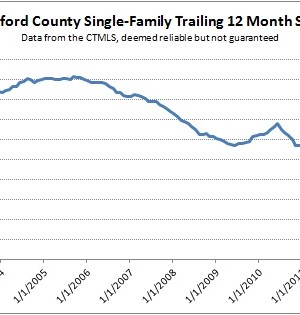
Our research shows that the number of single-family home sales in Hartford County peaked in 2005 at just over 9,000 properties. Sales quickly fell to the lower 6,000s by 2008, and remained about there in 2009 before falling to the upper 5,000s for 2010. Single-family home prices didn’t peak until 2007, fell 14% in two years, and then rebounded a bit in 2010. It’s still not clear to us why the average home price increased this year, though it’s encouraging that they didn’t fall further. Our current theory is that the mix of sales changed to included more larger (higher priced) homes.
Looking Forward
We don’t see any major changes in the big picture story, so we expect 2011 will bring more of the same. Local employers seem relatively stable in that there have not been major layoff announcements recently, but lots of people are still looking for work. And thrift continues to be a virtue, so the rank and file are less likely to reach for a larger home. We think the number of deals will remain in the vicinity of 6,000 for the year, and that prices will be flat-to-down for the region overall. We expect mortgage rates to continue to slowly rise, though not jump so much that buyers feel their purchasing power has been taken away. Basically, we expect that it will be another year in which homes have to be priced and marketed well in order to sell.
That said, we have some disagreement about the specifics. Rather than settle it internally, we thought it would be more fun to have a public airing of differences, so that bragging rights can be established at the end of the year.
Number of Transactions
One of the largest differences in the market between then and now is the number of transactions. Neither of us believe that they will return to previous levels, but we do have a bit of disagreement over the direction they’re heading.
- Amy: Sales volume is going to stay flat or go down versus 2010 for Hartford County … it’s going to get worse.
- Kyle: Sales volume is going to stay flat or go up slightly versus 2010 for Hartford County … we’re stabilized and rebounding.
Mortgage Rates
The Federal Reserve’s current Quantitative Easing program is clearly not holding mortgage rates down. So how high will they go in the coming year?
- Amy: Interest rates will fluctuate between 5% and 6.5% during the year. The slow increase will cause some buyers to pull the trigger sooner than they had otherwise planned.
- Kyle: Interest rates will increase, though it’s not clear to me how high they’ll go. As long as inflation fears don’t take off, they should remain low enough for people to actually get mortgages.
Bonus Predictions
- Amy: Short sales are going to be a lot more common. I am not a fan of short sales because my buyers wait and wait for months to hear back from the bank, never do, and eventually move on out of frustration.
- Kyle: The requirement that all condo associations update their FHA approval will cause delays for buyers. Condo associations are run by volunteers. Ideally their management companies, professional property managers, will make sure the associations understand the benefit of being FHA approved, but I’m sure there will be some complexes out there that just forget to go through the process.
- Kyle: This year there is no obvious real estate storyline, like there has been for the past few with the Federal Home Buyer Tax Credit. But as an industry, selling is easier when there is either a big carrot or a big stick out there, so I have no doubt one will be manufactured. I’m thinking that after a couple years of credit carrot, we’re going to be transitioning to the stick this year. Two leading candidates are “Buy now before prices start to rise” and/or “Buy now before mortgage rates rise.”
We’ll see what happens … it’ll be an interesting year in Greater Hartford real estate!
Readers, do you have any predictions? Related to real estate or in general?
A Decade of Hartford County Real Estate Transactions
Yes, we know we are dorks. You know we are dorks too and it doesn’t hurt our feelings if you call us that. And we also know that you like these data posts, so you are at least a little dorky too. Don’t worry, we won’t tell anyone…
The local MLS that we are members of has been collecting data electronically since 2000. We thought this would be a good opportunity to do a data dump and see what’s happened during the last 10 years with single family real estate sales in Hartford County.
One of us (not Amy) had the enviable task of downloading 83,605 records regarding closed single family sales in Hartford County from the period of January 1, 2001 through December 31, 2010. As always, all of the data we’ll talk about is from the CTMLS and is deemed reliable but not guaranteed.
What was the most expensive home sold (publicly) in Hartford County during the last decade? Well, that sale took place in September 2003 when Mike Tyson sold his Farmington home for $4.1 million. That house, currently owned by the rapper 50 Cent, is now listed for sale at $9.999 million.
Yeah, yeah, we know all about 50 Cent and the smack people talk about his house. What was the second most expensive house then? The second most expensive house publically sold in Hartford County went for $3.92 million in Avon in May 2007.
How many houses sold over $1 million in the last decade? Five hundred twenty six houses sold for $1 million or more since 2001 in Hartford County. The top ten most expensive homes sold were all in Farmington or Avon. Out of the top 25 most expensive homes sold, all but four of them were located in Farmington or Avon. So, if you need a really expensive house in Hartford County, it’s probably best to start your search in Farmington or Avon.
Alright Amy, we’re not all millionaires here. How about some charts about how sales prices and sales volume changed in the county over the decade…

So…
1. Average prices peaked in 2007.
2. Average prices bottomed in 2009 and rebounded in 2010.
3. Transactions peaked in 2004-2005.
4. Have we seen the bottom for the number of transactions?
Why do prices continue to rise in 2006 and 2007 even as sales volume was already falling? We have some theories, but need to do some more research. Is it herd mentality? Was it new construction continuing to come onto the market? Do other markets (like the stock market) also exhibit this behavior?
What does this imply for buyers sitting on the sidelines waiting for the bottom? Have they missed it? Or is the price increase in 2010 attributable to mix of sales?
It seems as though people just aren’t moving as much as they used to. The recent trend of 6,000 deals per year in the County is well below the nearly 9,000 deals per year that were happening from 2001 through 2006. Maybe people used to move hither and thither for jobs, but now they don’t. That’s a lot fewer real estate deals for us agents to divide up amongst ourselves.
As often happens, we came out of this with more questions than answers. What do you guys think – any theories? Maybe we’ll follow up on some of these if we reach any conclusions.
Also, we have this data broken down by every single town in Hartford County. If you’re interested in a specific town, email us and we’ll send you the charts.