Archive for the 'West Hartford' Category
Willimantic Victorian Days 2011
This weekend is a terrific opportunity to see Victorian architecture … it’s the beginning of Willimantic Victorian Days 2011! Of all the exciting things to do this weekend in Greater Hartford, this should be number one for old house people. Festivities extend all weekend, with a highlight being the 13th Annual Victorian Homes Tour. Fourteen homes are scheduled to be open this year. The complete schedule breaks down the different events and activities held in addition to the House Tour.
If those homes aren’t enough Victorian architecture for you, come check out two Victorians in the West End of Hartford on Sunday during their open houses. 101 Kenyon Street and 171 Girard Avenue will be open from 1:00 to 3:00.
Finally, those experiencing Victorian home overload can tour a spacious and modern condo at the Grosvenor House on Prospect Avenue in West Hartford. Other units in the complex will also be open for tour from 1:00 to 3:00 on Sunday, allowing you to compare and contrast. I think this one’s the best of the lot, not that I’m biased or anything…
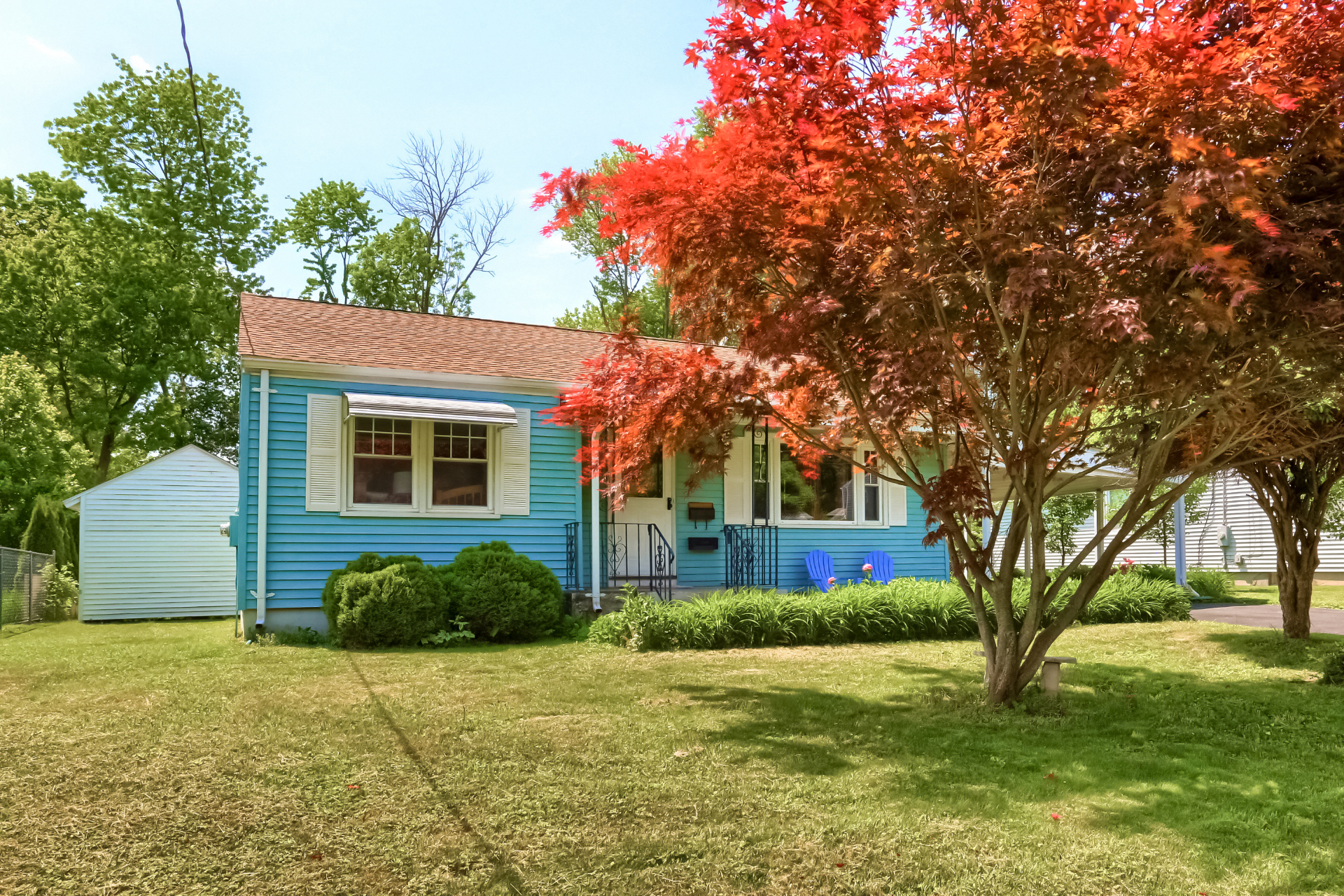
82 Ballard Drive, West Hartford
This 1,528 square foot two bedroom, one-and-a-half bathroom Cape has the layout of a traditional Colonial and is located in the popular Morley elementary school district.

The first floor features a front-to-back living room with fireplace and bay window. There is a formal dining room with chair rail and panel molding and a built-in corner hutch. The kitchen overlooks the backyard and has an eat-in nook. A paneled den leads to a screened-in porch. A half bath completes the first floor.
Upstairs you’ll find two large bedrooms with good closet space. The master bedroom has a balcony that overlooks the backyard. There is a full bathroom with a soaking tub and shower.
The home also has hardwood floors throughout, a partially finished basement and a 2-car garage.
82 Ballard Drive is offered at $289,000. If you’d like to see this home, please have your agent arrange a showing or call me at 860-655-2125 to schedule a visit. More details and a photo tour are available.
South Quaker & Flatbush Playground, West Hartford
Another report from the field by our interprid playground reporter.

Overall Rating: 4 out of 5 slides
Location: 877 Flatbush Avenue, West Hartford, at the corner of South Quaker Lane.
Hours: Dawn to Dusk
A great place for younger children to go burn off some energy in a controlled environment. There is just one (large) piece of equipment, so no need to worry about anything distracting from focused playing!
Playscape: The sole entertainment at this smaller playground is the newer playscape, which is labeled as ages 2 to 5. It seemed ideal for the younger end of that range as there is nothing too difficult or seemingly dangerous.
Swings: None.
Other Stuff: Nothing inside the fence. Well, a tree and some grass, but that hardly counts. However, the park is on the corner of a very large field that is used for soccer.
Facilities: None.
Social Opportunities: Limited. Not sure what the whole story is behind this little playground. It kinda looks like it was added on to the soccer fields so that younger siblings would have a place to entertain themselves while the older kids had practices or games. We haven’t been while the main fields were in use, but on two visits we only saw one other child playing.
Potential for Escape: Low. There is a large fence surrounding the entire playground, with the entrance quite far from the playscape. It’s a good place for high energy kids to go run around for a while without too much to worry about.
Related Posts:
Playground Review: Elizabeth Park, Hartford
West Hartford Revaluation 2011, Part II
The other day we covered the basics of the upcoming West Hartford property revaluation. As a quick reminder, the process is underway, and new “Market Values” will be available and distributed in the October time frame. Homeowners with concerns about their number can go through the “Informal Hearing” process and appeal it beyond that if needed.
Phasing In Market Values
We tried to keep things simple last time, focusing on the basic revaluation process and timeline. This required leaving out an important detail about how the 2006 revaluation was implemented. When the updated Market Values were released in the fall of 2006, residents learned that property values had increased dramatically since the previous revaluation in 1999. Rising property values are usually a good thing for owners, since it increases the equity in their home. However, this time there was a catch.
The revaluation found that residential property increased in value more than commercial property, which meant that homeowners would pay higher taxes as they collectively took over some of the tax burden from commercial property owners. In addition, residential property appreciation varied by house, which meant that homeowners with the largest gains in home value would see an even larger increase in property taxes.
West Hartford decided to use a Phase-In to more gradually transition to the new Market Values. Phase-Ins are relatively common, and increase the taxable market value of a property in stages so that owners with the biggest gains in property value aren’t hit with large tax increases all at once.
The Town allowed taxable values to increase by a maximum of 25% in the first year. Since nearly all homes had appreciated by more than 25%, the remaining change in Market Value was distributed equally to years 2 – 5 of the phase-in. By Grand List 2011, everyone would be taxed based on their 2006 Market Value.
Freezing the Phase-In
Public concern about the revaluation grew over the first two years, and focused on two main points. First, that the October 2006 revaluation date may have been the peak of the market. Some argued that the values were unfair because homes couldn’t be sold at those prices less than two years after they were set. The second concern was that homeowners were being taxed on unrealized gains. Owners didn’t have any extra money in their pockets from their home’s appreciation, so how could they afford to pay their increased taxes without selling their home? The argument typically used long-time residents who were on a fixed income as examples. The Town Council voted to freeze the phase-in after the second year, locking in the Grand List 2007 values.
Many of the effects of freezing the phase-in were correctly identified in real time at public meetings. Residential property had increased in value more than commercial property, so freezing the phase-in shifted more tax burden to businesses, which were struggling with a weakened economy. It also shifted more of the burden to motor vehicle owners. Finally, homes with less than average appreciation ended up paying more taxes than they otherwise would have, while homes with more than average appreciation paid less than they otherwise would have.

In the two years since the freeze was implemented, we’ve learned even more about the effects. One of the most interesting is that the revaluation was not done at the peak of the market. Average prices continued to rise through 2007 even though the number of transactions was already falling. Although we didn’t publish the chart, the trend was similar in West Hartford. Additionally, the decline in prices over the subsequent down years has not been nearly as steep in West Hartford as it has in other areas of the region or the country. The value of many homes continues to be fairly close to the numbers identified in the 2006 revaluation.
As a specific example, consider a very typical 3 bedroom, 1.5 bath home in West Hartford Center. The 1999 revaluation set the Market Value at $148,600. Revaluation 2006 determined that it had appreciated to $280,286. The property had sold a couple years before for about that price, so in this case the Assessor did pretty well.
Revaluation 2011 will likely show that its Market Value has not changed dramatically. This particular home was recently listed for sale again, at right around $300,000, and went under contract very quickly, as most do in this price range. However, because the phase-in was frozen, the home is on the tax roles as being worth $209,384.
Analysis of Grand List data from the Assessor’s office shows that had the Phase-In been completed as planned, the mill rate for the coming year would be about 32.65 rather than 39.44. We calculated this number by removing the Phase-In Exemptions from the assessed values and then allowing the mill rate to decrease until the property tax revenue equaled what the Town expects to raise in the coming year. Our estimated mill rate may not be exactly right, but it’s close.
Planning for the Fall
Owners are in a similar position as 2006 when looking towards the 2011 revaluation. Within the residential side of the Grand List there are large variations in how home prices differ from the frozen phase-in values. Changes to the commercial side of the Grand List, which makes up 16.4% of property values in town, are also uncertain. It is difficult to project how the tax burden may shift. It seems prudent to wait until the fall to understand exactly where we stand before getting too concerned about different possibilities.
In the meantime, residents need to understand a few key points. The revaluation will begin to go public in the fall, and individual home owners will have an opportunity to challenge their Market Values. There will hopefully be a public discussion about how to transition to the new Market Values. Finally, if the Phase-In had been completed (rather than being frozen), the order-of-magnitude tax impact on owners would have been in the +5% to +10% range, though it would have varied considerably based on the assessment of individual homes.
West Hartford Revaluation 2011
It’s time for a property revaluation in West Hartford, something the state requires towns to do every five years.
Revaluations can seem scary to homeowners, and are often associated with tax increases. Hopefully the discussion that follows will help prepare you for the process, so that you understand what is happening and how you may be impacted as a West Hartford homeowner.
The Big Picture
Connecticut towns generate a significant portion of their revenue from property taxes. In the 2010-2011 Budget, West Hartford expected to collect about $192 million in general property taxes, which would fund nearly 82% of the $234 million-ish budget.
Property taxes are levied against residential property, commercial property, personal property (really business property), and motor vehicles. Just about everyone contributes in one way or another. Ideally the cost of running the town is balanced between the different constituents fairly, since they all utilize different services. As the chart to the right shows, there is about $10 billion in property in West Hartford right now.
Running the Numbers
Property tax calculations begin with a Market Value. This number is what the Town feels your home is worth, or at least what they felt it would sell for back in 2006 during the previous revaluation. Since doing a custom analysis for each and every property in town is unrealistic, they utilize a valuation model that is guided by market transactions.
Between revaluations, the main way that Market Value can change is if there have been improvements to a property. The easiest example is if someone buys a vacant lot in a neighborhood and builds a new home on it. Obviously, the property is more valuable now that it has been “improved” and the Market Value would increase to account for those changes.
Homeowners making other “improvements” to their property may, or may not, cause their Market Value to change. The Assessor’s website notes that maintenance and cosmetic changes generally do not impact the Market Value, while structural renovations or improvements may. For example, replacing a roof or furnace won’t lead to a higher tax bill. The town is more interested in knowing if you added central air, finished the basement, or built an addition. But no matter what work you do, or how it impacts taxes, it’s important for any work you do to be properly permitted and inspected.
Once the Market Value is determined, it is multiplied by a state mandated 70% assessment ratio to calculate the Assessed Value of the property. The Town uses the total Assessed Value of all property on the Grand List to set the Mill Rate so that sufficient revenue is generated to fund the budget.
People are sometimes confused about how their home’s value, the mill rate, and the budget interact to determine their property taxes. The budget sets the total level of spending — that’s what necessitates taxes in the first place. Using property values is simply a strategy for distributing the burden across owners, while the Mill Rate is a mathematical plug to make the revenue equal the expenses.
Revaluations usually shift the burden in two ways; they reallocate between property classes, and also between owners within each class. Residential and Commercial property are the two main property classes, though the chart above shows that there is far more Residential in town. Revaluations also reallocate amongst the individual property owners within a class, which unfortunately can lead to winners and losers.
The Upcoming Revaluation
The Assessor’s department has published a timeline that outlines the entire process. Right now they are gathering information for the 2011 Grand List. You may have seen the data mailers that they sent out last spring requesting information from homeowners. The goal of that mailer was to get everyone to confirm that the town had the correct information for their property.
New Market Values will be mailed out in October. Homeowners who don’t like their new values are able to schedule a meeting, called an “Informal Hearing,” to explain their position. Someone from the Assessor’s office will discuss the revaluation process and note the concerns before reviewing the value. Owners should bring documentation to the meeting to support their claims of unfair assessment.
Supporting data is very important to the dispute process. The town recently unveiled a brand new Geographic Information System (GIS) Website. It can be accessed via the Assessor’s home page, and is a very powerful tool for researching West Hartford property records.
One of the new features that was not available in the previous system is called “Sales Mapping,” which is supposed to let you pick out a property (yours) and then search for comparable sales. It may be a helpful tool, but at this point there is only sales data through 2009. The other main way to find data to dispute your Market Value is to reach out to your favorite Realtor for help.
Results from the informal hearings are also mailed to homeowners. If there is still a disagreement about value, owners have one additional opportunity to be heard, petitioning the Board of Assessment Appeals. More information about both the revaluation process and the various stages of appeal can be found on the town website in the Assessment Office area.
Hopefully the upcoming revaluation will be smooth and uneventful. Homeowners play a role in the process and need to understand how property taxes work, and how to dispute unfair Market Values.
Related Posts:
Property Revaluation Schedule for Other Towns in Hartford County
Property Taxes and Revaluations