Archive for the 'West Hartford' Category
Home Pricing Strategy for the Internet
You’re ready to sell your house and you’ve met with your agent to go over their pricing recommendation and marketing plan. The agent feels your house would be competitive in the market if it was priced anywhere between $290,000 and $300,000. So what do you choose as a listing price? There are lots of options, but the most popular choices in this situation would most likely be $299,000 or $299,900 or $300,000.
One aspect of pricing that most people don’t think about is how the price you choose affects the number of people that find your home through their internet searches. For example, let’s say you choose to price your home at $299,000 or $299,900. You want the psychological advantage of pricing your house just under $300,000, without much downside to you. There is an issue with this strategy when it comes to most real estate website searches though.
Pretend you’re a buyer. Most real estate websites use drop down menus to allow you to choose your price range when doing a property search. The values in the drop down menus are static (you can’t change them) and typically in increments of $10,000, $25,000, or $50,000. If I’m a buyer searching for homes up to $300,000, it’s perfectly fine if you price your house at $299,000 or $299,900. I’ll see the result. But what if I’m a buyer and I’m looking between $300,000 and $400,000? I won’t find your house because these static searches have blocked you out.

For example, right now in West Hartford, according to the MLS, there are 13 houses actively for sale between $290,000 and $300,000. One of these houses is priced at $300,000. Nine of these houses are priced between $299,000 and $299,900. Two of these houses are priced at $298,000. The 11 houses that are priced between $298,000 and $299,900 are missing all of the buyers that are starting their search at $300,000 on the web, while the one house priced at $300,000 is showing up for the buyers that are searching up to $300,000 and those with a price range starting at $300,000. Which seller do you think has more people finding them online? Which seller would you want to be?
Realtor.com recently updated their website and replaced their pricing drop down menus with text boxes. Unfortunately most people have been conditioned to search using the typical incremental values of $10,000, $25,000, and $50,000. Most buyers will not think to start their search at, say, $297,000 to pick up all of the properties that are priced at $299,000 or $299,900. Agents see this similar situation in the MLS. We have text boxes where we enter the price ranges when setting up property searches for our buyers. The agent needs to be astute enough to manually enter a starting price slightly below the buyer’s range in order to pick up properties ending in $XX9,000 or $XX9,900. Agents, like buyers, sometimes have tunnel vision and don’t necessarily do this. So the buyer is missing out on potential matches. One of which may be your home.
If your goal is to have as many buyers find your house as possible, it may be best to go against the conventional pricing psychology and choose the slightly higher price that starts with a bigger number. More people will find your home during their online searches. Besides, when I’m showing a house that’s priced at $299,900 and the buyer asks me how much it is, I say “$300,000″ because in reality, that’s what it is. You’re not really fooling anyone.
Tiny Houses in Connecticut
I saw this structure while driving on Interstate 91. It’s most likely not a tiny house since the Jamaica Cottage Shop doesn’t claim to make them. But it did get me thinking about the idea again.
A couple years ago I saw my first photo feature on so-called tiny houses. For those not familiar with the concept, a tiny house tries to pack all the essential features of a dwelling into a very small structure. Some of the smallest versions check in at less than 100 sqft. It’s a combination of minimalism and design efficiency. How little can you survive with? And how well can you organize those essentials into a functional home?
My interest was piqued by some of the plans by Tumbleweed Tiny Houses. Their website has pictures and schematics for many of their designs on the website, though it’s difficult to truly understand just how small they are. You can take a video tour of founder Jay Shafer’s 89 sqft abode to give you a sense of scale. They’re small. Really small.
Last fall a Yale graduate student gained regional attention for the tiny home she designed on the back of a trailer. You can learn more about her project in this article by a New Haven Register reporter and see a video tour made by the Hartford Courant.
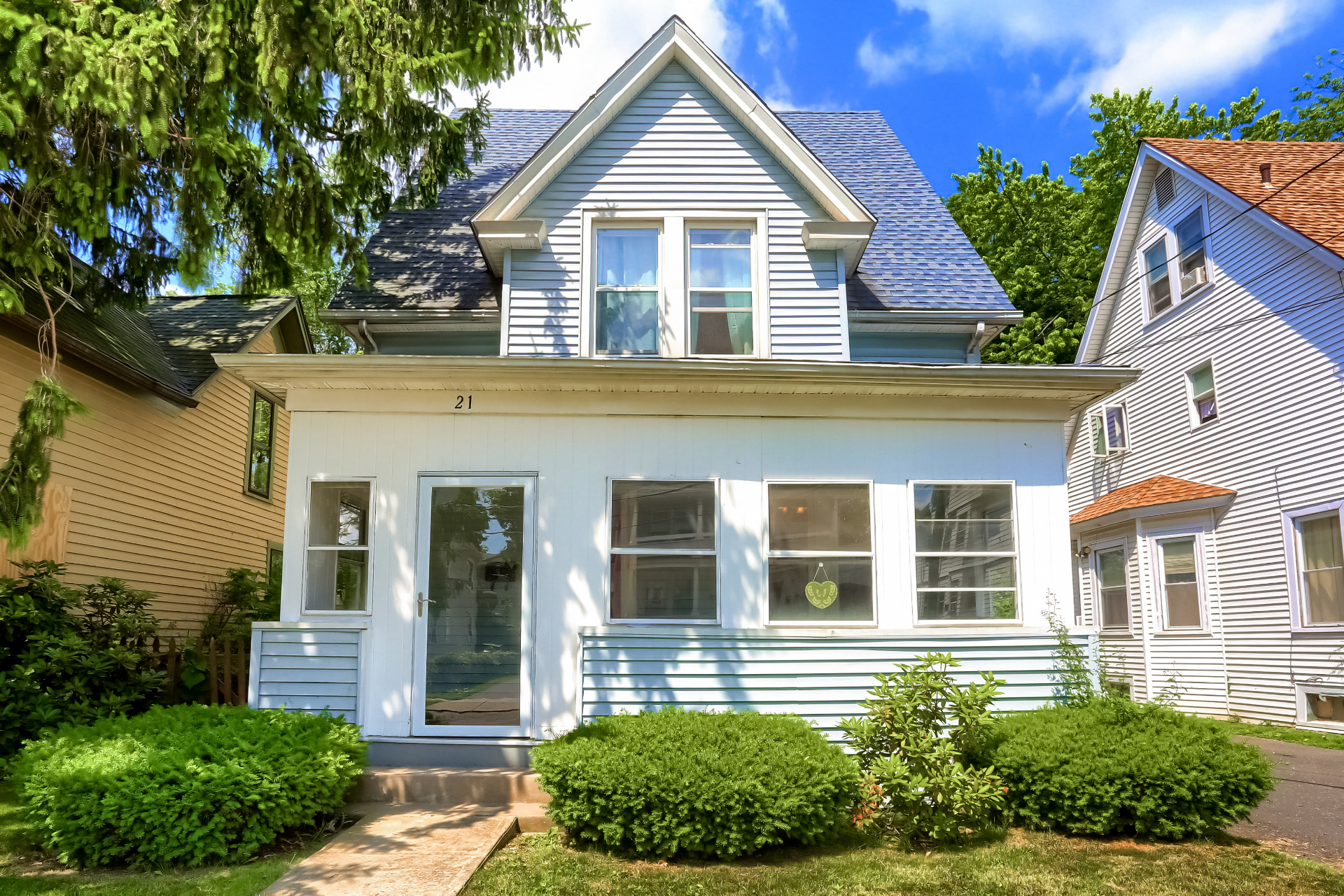
These stories are probably the closest that most of us will ever come to experiencing a tiny house. There is, however, some hope for a small house. West Hartford has one property in particular that has the potential to be a very nice small home. It’s about 650 sqft and at this point is in need of a total makeover. Amy’s sick of hearing me talk about it, but it could be a really great place if “tiny house” principles were applied.
There could be a decent sized great room with built-in cabinets to house the various electronic necessities and provide storage. I’m envisioning a kitchen further back and open to the main living area, with the bathroom behind that. There may even be room for another room that could serve as both a dining room and guest bedroom (if it utilized a Murphy Bed). Above the back portion of the house would be a sleeping loft that would be the primary bedroom and provide more storage. Finally, there is a full basement and all the possibilities it provides.
Alas, Amy and I will not be moving. But if anyone is interested in taking on a project like that, feel free to contact me…
Missing the Bus
I could hear the bus braking from down the street, with its distinctive whoosh. It was approaching the stop sign, just across the intersection from the bus stop, and I was still over half a block away. Adrenaline surged in preparation for a mad dash to the corner - or at least close enough to the corner to be able to catch the driver’s eye. It was an instinctive reaction, but no longer necessary. I was not on my way to the bus stop.

For five years I rode the CT Transit bus system downtown to work. I saw it as a way to avoid the hassles and expense of driving to work every day, and doing my little part to reduce the number of cars on the road. Even though it took longer than driving myself, it was nice to just be a passenger and enjoy the ride.
People generally rode the same bus every day and sat in the same areas on the bus. Mornings were more crowded, but consistently quieter as the riders kept to themselves and presumably reflected on the upcoming day. Small conversations broke out here and there but were generally at low volumes and confined to a seat or two. Standing-room-only buses and basically empty buses were always the quietest, with the most interaction on buses that were about half full.
One of the best benefits of riding the bus was having the opportunity to meet fellow commuters. I had ten opportunities per week to interact with folks and developed a whole network of “bus friends” that I would otherwise have never met. At first we would just say hello and cover the polite conversation staples like current events, sports or the previous night’s TV shows. But over time you get to know people and begin to learn more about them. Like their name, their job and in some cases their family.
I still ride the bus downtown periodically to meetings and events. It’s great to catch up with friends I haven’t seen in a while and share stories about what’s going on in my life. But it’s just not the same without riding regularly - I’m out of the loop. Even in today’s world of digital connectedness, I can’t help but feel that I am missing the bus.