View from Riverfront Park
News and views about real estate in Greater Hartford

Archive for the 'Taxes' Category

Hartford Revaluation 2011 – Mill Rate Estimate

Bushnell Park Fountain at NightThursday’s Hartford Courant contained an article and photo gallery projecting possible tax bills for a number of different properties in the City of Hartford. Their story contained just enough information to figure out what their model of the revaluation’s results say about the mill rate and residential assessment ratio.

The Courant is projecting that the three property classes will have assessment ratios of 70% for commercial, 50% for apartments (which now includes four-family buildings) and 30.6% for residential (condos, single-families, two-families and three-families). They expect the mill rate to be somewhere between 76 and 77, and used 76.79 in their calculations.

Hartford property owners interested in estimating what their July 2012 property taxes based on this model can use the following formula:

(Market Value) x (Assessment Ratio) x (Mill Rate/1000) = (Property Taxes)

So for a residential property this comes out to be…

(Market Value) x (30.6%) x (.07679) = (Property Taxes)

… which is about the same as …

(Market Value) x (2.35%) = (Property Taxes)

Owners of commercial and apartment properties would need to start with the first formula and plug in the appropriate assessment ratio.

Since we are still in the early stages of the revaluation process, this is a rough estimate and a lot can still change before tax bills go out at the end of June of next year.

Thoughts & Observations

The most challenging part of modeling the Hartford tax system is getting the residential assessment ratio correct. For the coming year it is supposed to be set so that the overall tax burden of residential property class increases by 3.5%. That was a compromise agreed to by the various stakeholders last spring and passed into law by the state legislature. The primary article attributes the 30ish percent assessment ratio to City Assessor John Philip, and lead author Jenna Carlesso confirmed that he provided that number.

The Courant is forecasting that the mill rate will actually increase under the new system. This is a bit of a surprise since the City’s overall goal is to start reducing the mill rate in order to help attract more businesses.

Although it seems counter-intuitive, it’s okay if the mill rate rises. The data clearly shows that the tax burdens for commercial property owners is decreasing, which is more important than the perception caused by the slightly higher mill rate. In the previous system we had an additional layer of complexity called the Business Surcharge – an additional tax over and above the standard tax – that is now gone. The City has taken an important first step to making the commercial mill rate directly comparable to other towns in the state.

Since the City Assessor has not come out with an official set of projections, we think it is important to continue to develop our own model on what could happen. We’ll keep trying to get data from the Assessor and hopefully have a second set of projections to share in the coming weeks.

Presumably the Courant team succeeded in getting additional information from Assessor Philip as inputs to their model. In thinking about repeating the calculation on our own, we don’t see any way to accurately do it without knowing the aggregate market values for each property class for both last year and this year. Last spring the previous City Assessor provided us a good amount of information, but not the breakdown of the residential class. Since the rules of the game changed to move four-families from the residential assessment bucket to the apartment bucket, we would need to calculate the impact of that change before being able to distribute the tax burden correctly and arrive at a potential mill rate.

Using the Courant’s Data to Calculate Their Projected Mill Rate

For those that are curious, here’s how we used the data that the Courant published to back into the mill rate and residential assessment ratio they are projecting.

After inputting all the data into a spreadsheet, we focused on the commercial and apartment properties. We knew the assessment ratios, so we were able to calculate the assumed mill rate. Once we knew the mill rate, we were able to use that in the residential properties to calculate the assessment ratio. Fortunately the values were consistent across all 9 properties once rounding errors were considered.

Here is our table, the cells with blue text are inputs while the cells with black text are calculations.

Hartford Courant Hartford Revaluation 2011 Model


Related Posts
Hartford’s Revaluation 2011 – Update
Overview of Hartford’s Property Tax System

West Hartford Revaluation 2011 – Mill Rate Estimate

Anyone Been to the Beauty Studio Recently?Last Tuesday we wrote about the West Hartford revaluation, focusing on the informal hearings that allow individual property owners to challenge the market values that they received in the mail from the Town.

Today we turn our attention to analyzing the big picture results of the revaluation. Amanda Falcone’s piece in the Thursday’s Hartford Courant quotes West Hartford Assessor Joseph Dakers Sr. as saying the new market values will “likely cause the town’s grand list to decrease by 5.6%, or about $316 million.”

Based on that statement, and a number of additional steady state assumptions detailed below, we’re projecting the new mill rate to end up somewhere between 33 and 34 mills. If accurate, it would represent about a 2% average increase in the tax burden on real property owners, and a 15% decrease taxes on personal property (business equipment) and motor vehicles.

We would expect individual property owners to experience much larger swings in their tax burdens depending on their specific properties. Some will experience larger increases, while others will see their taxes go down. It will all depend on how their individual properties were assessed during each of the two previous revaluations. A ballpark figure for future tax burden can be calculated using the following formula:

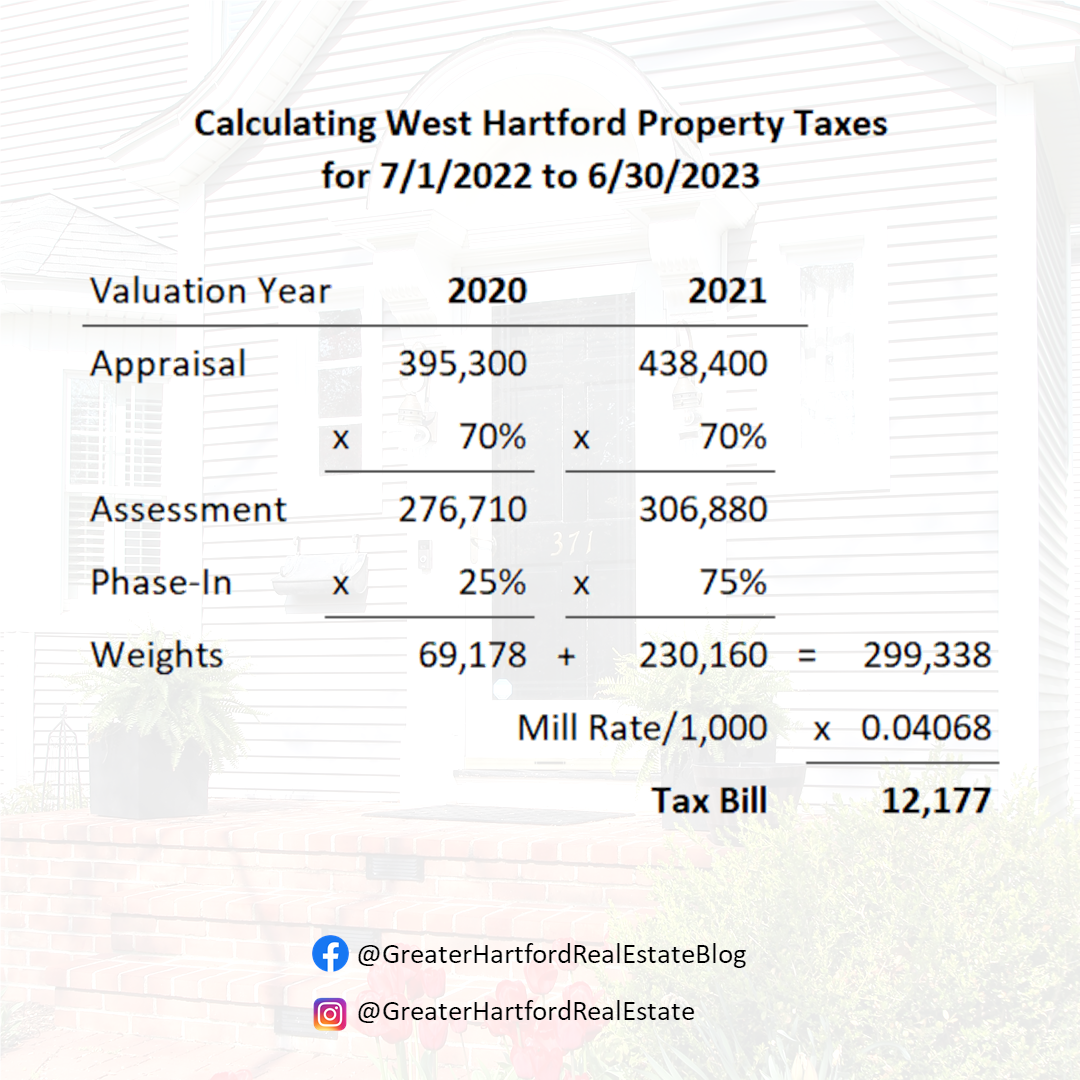
(Market Value) x 70% x (mill rate/1000) = Tax Bill

Our mill rate is a very rough estimate, but we feel it is an accurate depiction of what is likely to happen if the proposed market values hold and basically everything else stays the same. It analyzes the impact of the revaluation without addressing any other factors that may impact the Town budget.

Please feel free to check our work, which is shown below in detail, and post your thoughts in the comments.


Step 1: Interpreting the Data
The whole calculation is based on the Town Assessor’s statement that $316 million is about 5.6% of Grand List 2010. So:

(Grand List 2010) x 5.6% = $316,000,000

(Grand List 2010) = $5,642,857,143

The context of the quote doesn’t specify exactly what the Assessor means when he says “Grand List.” Is he talking about the market values, Gross Assessment (70% of market value), or the Net Assessment (after all exemptions are subtracted out)? Is it for only Real Property or does it include Personal Property and Motor Vehicles?

Last year I worked with the Assessor a bit when Grand List 2010 was released, modeling the whole system. In comparing the “Grand List” number he seems to be working with now to that spreadsheet, my conclusion is that he is talking about the total Gross Assessment for Real Property. Since the revaluation is focused exclusively on Real Property, this seems like a reasonable conclusion. Below is a summary of the taxes generated last year by Grand List 2010 (Note: Gross Assessment and Exemptions sourced from a report emailed to me by the Town Assessor in February 2010).

West Hartford Grand List 2010

These calculations show that the Town would have sent out property tax bills totaling about $197 million. Page F-2 of the 2011-2012 Annual Town Budget shows a table summarizing the Town’s revenues, discussing property taxes, and showing the tax collection rate. It shows Current Property Taxes in the Fiscal Year 2012 Adopted Budget as $195,496,802. So our calculation of the billings is quite close to what the Town expected to receive – a good sign. Our calculation gets even closer to the target when we include their assumed 99% tax collection rate.

$197,118,711 x 99.0% = $195,216,824

Step 2: Defining Assumptions
The agreement of our calculation with the Town Assessor’s quote and the expected revenue provide enough confidence to move on to the next stage of the calculation. But before we can run more numbers, we need to be explicit about our assumptions. Here are the five main assumptions in our forward looking analysis and projections.

1. The Town Assessor was properly quoted in the Courant, and we have properly interpreted what he said. The discussion above provides two independent points of collaboration, which makes us feel good.

2. Personal Property and Motor Vehicle Gross Assessments remain unchanged.

3. Town revenue raised from Property Taxes remains unchanged.

4. All phase-in exemptions are eliminated. We’ve discussed the frozen phase-in elsewhere and will skip over it this time. It’s important, but is not the focus of this analysis.

5. All “normal” exemptions remain unchanged.

Step 3: Projecting Grand List 2011
Now we’re ready to update the table from above to reflect our assumptions for Grand List 2011.

West Hartford Grand List 2011

First we calculated the new Gross Assessment for Real Property by subtracting $316 million. Next, we eliminated the Phase-In Exemptions, so everyone is taxed based on the market values determined by this revaluation. Finally, we optimized the Mill Rate so that the total Tax Revenue exactly equals the previous table.

The resulting 33.67 mill rate is more precise that we can reasonably calculate given the rough nature of this estimate, so at the top of the story we said that it would end up somewhere between 33 and 34.

So there it is, our attempt to ballpark the West Hartford mill rate for the tax year starting in July 2012. We have no doubt that there will be factors outside of the revaluation that will impact the Town, and therefore the budget. However, we hope this provides a starting point for understanding how the revaluation will impact property tax revenue.

Again, please feel free to post questions, concerns, and thoughts in the comments section.


Related Posts
West Hartford Revaluation 2011 – Informal Hearings
West Hartford Revaluation
West Hartford Revaluation, Part II
Property Taxes and Revaluations

Property Taxes in the City of Hartford

One of the most difficult conversations that I have as a real estate agent is explaining the property tax system in the City of Hartford.

The Elizabeth Park Annual Garden in HartfordMost of the time the subject comes up as I’m touring around with a buyer and trying to cover various home buying subjects as we drive from one property to the next. My client will casually ask about taxes, expecting an answer along the lines of “They’re low/high compared to other towns.” In most towns I can give an answer like that, and then also talk about where that town is in the revaluation process.

When we’re touring Hartford, my answer is usually, “They’re complicated; would you like the short version or the long version?” To their credit, most buyers seem to ask for the long version. They want to know how it works, and what possibilities exist in the future. After all, they’re going to be on the hook for making the tax payments if they buy a house in the City. And as their agent, I feel it’s my responsibility to make sure my buyers have all the information they need to make an informed decision.

I’ve spent a considerable amount of time trying to understand exactly how the taxes work in Hartford.

I’ve talked to the City Assessor and various staff members to work through the details of the current system at different points of time. I’ve talked to our elected officials at both the City and State level to hear the arguments for why they have advocated for different implementations. I’ve sat in on presentations and negotiations between different constituency groups as they hash out a forward looking plan.

Despite all this effort, I still cannot neatly summarize property taxes in the City of Hartford for someone with basic municipal property tax knowledge. It’s just too complicated. I can’t even build a spreadsheet/model that will predict the coming year’s taxes based on an expected City budget. There are too many moving parts.

The best I can do is create a resource, so that those interested in learning about how property taxes work in the City of Hartford have a central place to go for information. I’ve made an effort to summarize as best I can, and I’ve also collected and sorted links to over 50 articles, presentations, and videos on the subject dating back to 2006.

The City of Hartford: Property Taxes page is a work in progress, and I definitely appreciate feedback and comments on how to make it more helpful, more accurate, and generally better.

West Hartford Revaluation 2011

Blue Back Square, West HartfordIt’s time for a property revaluation in West Hartford, something the state requires towns to do every five years.

Revaluations can seem scary to homeowners, and are often associated with tax increases. Hopefully the discussion that follows will help prepare you for the process, so that you understand what is happening and how you may be impacted as a West Hartford homeowner.

The Big Picture
Connecticut towns generate a significant portion of their revenue from property taxes. In the 2010-2011 Budget, West Hartford expected to collect about $192 million in general property taxes, which would fund nearly 82% of the $234 million-ish budget.

Property taxes are levied against residential property, commercial property, personal property (really business property), and motor vehicles. Just about everyone contributes in one way or another. Ideally the cost of running the town is balanced between the different constituents fairly, since they all utilize different services. As the chart to the right shows, there is about $10 billion in property in West Hartford right now.

West Hartford Grand List 2010Running the Numbers
Property tax calculations begin with a Market Value. This number is what the Town feels your home is worth, or at least what they felt it would sell for back in 2006 during the previous revaluation. Since doing a custom analysis for each and every property in town is unrealistic, they utilize a valuation model that is guided by market transactions.

Between revaluations, the main way that Market Value can change is if there have been improvements to a property. The easiest example is if someone buys a vacant lot in a neighborhood and builds a new home on it. Obviously, the property is more valuable now that it has been “improved” and the Market Value would increase to account for those changes.

Homeowners making other “improvements” to their property may, or may not, cause their Market Value to change. The Assessor’s website notes that maintenance and cosmetic changes generally do not impact the Market Value, while structural renovations or improvements may. For example, replacing a roof or furnace won’t lead to a higher tax bill. The town is more interested in knowing if you added central air, finished the basement, or built an addition. But no matter what work you do, or how it impacts taxes, it’s important for any work you do to be properly permitted and inspected.

Once the Market Value is determined, it is multiplied by a state mandated 70% assessment ratio to calculate the Assessed Value of the property. The Town uses the total Assessed Value of all property on the Grand List to set the Mill Rate so that sufficient revenue is generated to fund the budget.

People are sometimes confused about how their home’s value, the mill rate, and the budget interact to determine their property taxes. The budget sets the total level of spending — that’s what necessitates taxes in the first place. Using property values is simply a strategy for distributing the burden across owners, while the Mill Rate is a mathematical plug to make the revenue equal the expenses.

Revaluations usually shift the burden in two ways; they reallocate between property classes, and also between owners within each class. Residential and Commercial property are the two main property classes, though the chart above shows that there is far more Residential in town. Revaluations also reallocate amongst the individual property owners within a class, which unfortunately can lead to winners and losers.

The Upcoming Revaluation
The Assessor’s department has published a timeline that outlines the entire process. Right now they are gathering information for the 2011 Grand List. You may have seen the data mailers that they sent out last spring requesting information from homeowners. The goal of that mailer was to get everyone to confirm that the town had the correct information for their property.

New Market Values will be mailed out in October. Homeowners who don’t like their new values are able to schedule a meeting, called an “Informal Hearing,” to explain their position. Someone from the Assessor’s office will discuss the revaluation process and note the concerns before reviewing the value. Owners should bring documentation to the meeting to support their claims of unfair assessment.

Supporting data is very important to the dispute process. The town recently unveiled a brand new Geographic Information System (GIS) Website. It can be accessed via the Assessor’s home page, and is a very powerful tool for researching West Hartford property records.

One of the new features that was not available in the previous system is called “Sales Mapping,” which is supposed to let you pick out a property (yours) and then search for comparable sales. It may be a helpful tool, but at this point there is only sales data through 2009. The other main way to find data to dispute your Market Value is to reach out to your favorite Realtor for help.

Results from the informal hearings are also mailed to homeowners. If there is still a disagreement about value, owners have one additional opportunity to be heard, petitioning the Board of Assessment Appeals. More information about both the revaluation process and the various stages of appeal can be found on the town website in the Assessment Office area.

Hopefully the upcoming revaluation will be smooth and uneventful. Homeowners play a role in the process and need to understand how property taxes work, and how to dispute unfair Market Values.


Related Posts:
Property Revaluation Schedule for Other Towns in Hartford County
Property Taxes and Revaluations

Property Taxes and Revaluations

Icicles Glittering in the Sun

We’re sensing some confusion over the future direction of property taxes among some of our buyer clients and homeowner friends. We don’t know pretend to know exactly what will happen, but have a theory we thought we should share:


Town Budgets Determine Property Taxes, Not Assessments

You’ll notice that property values (assessments) do not figure into the property tax calculation. Even though your home, or the home you hope to buy, may have fallen in value since the last revaluation, you should not expect that to automatically translate into lower property taxes in the future.

The manner in which property taxes are calculated can be confusing to people, and revaluations add an extra level of complication. Back in the day, when home values only went up, revaluations were met with a combination of excitement and fear. Excitement since someone would be giving us an estimate of how much equity we had earned by owning a home in a rising market. But also fear because, “If my home actually doubled in value, and the mill rate stays the same, then my taxes are going to double!”

Although that statement it true, the mill rate will adjust any time there is a major change in the Grand List (the total value of all property). Every time there was a major increase in a town’s Grand List during a revaluation, the mill rate would decrease to keep the actual taxes paid roughly in line with previous years. Here’s a good example, the history of the mill rate in Newington. You can see that the mill rate actually falls most years in which there is a revaluation.

The goal of a revaluation is distribute the tax burden fairly across property owners. Properties in a town gain and lose value differently, so the state requires that towns catch up with those changes every five years. The only way a revaluation will make a meaningful impact on your individual taxes is if your property’s value changes in a dramatically different manner than the average property in town.

These days it’s difficult to know if a home has increased or decreased in value since the last revaluation – it depends on home price trends and the revaluation schedule in the specific town. But suppose there is a town where the prices have fallen 10% across the board since the last revaluation. Homeowners there should expect to see their individual assessments fall, but are also likely to see the mill rate jump.

At the end of the day, the town budget determines how much must be raised in property taxes. If the town budget is flat, then next year will be the same total tax as this year. The mill rate will be set to ensure that the appropriate amount of money is collected. Decreasing property values, unfortunately, have nothing to do with the level of municipal spending, which is what actually determines our property taxes.

« Previous Entries