View from Riverfront Park
News and views about real estate in Greater Hartford

Archive for the 'The Valley' Category

October 2010 Market Statistics

Here’s a quick look at how the Hartford County real estate markets performed last month. Closings in October reflect deals negotiated during the summer and fall depending on the amount of time between the contract date and the closing date. The data comes from the Connecticut Multiple Listing Service (CTMLS), which is deemed reliable but not guaranteed.

October 2010 Market Stats for Hartford County

Some Observations

There was a wide range in the percent change in number of transactions for this October versus last October. Most towns were considerably less active, though there were some positive towns. Glastonbury had 25% more sales than last year (6 deals), while Rocky Hill saw 3 more deals close for a 50% gain. At the other end of the spectrum there were 7 towns in which the number of deals fell by more than 50%. Hartford County overall saw a 38% decrease in the number of transactions for October 2010 versus October 2009.

Part of the reason for the drop in activity was the Federal Home Buyer Tax Credit. Last fall there was a version of the credit scheduled to expire at the end of November, before the program was extended for the final time. Many buyers planning to take advantage of the credit scheduled their closings for October and early November, so the activity this year should be less.

Buyers should have some very good choices in the market, as inventory levels show a buyer’s market for nearly all the towns in the County. The standard benchmark for a buyer’s market is when there is 6 months or more of inventory available. Based on recent activity, only four towns are NOT in a buyer’s market. West Hartford has the least inventory, at 5.3 months, while the other three are each much closer to the 6 month dividing line.

Sellers need to be willing to price their homes attractively if they really want to sell – this isn’t the time to stretch for that extra few thousand dollars. Buyers do have a lot to choose from and seem comfortable taking their time to make a decision. Sellers need to give them a reason to pull the trigger. Make sure the property shows as well as possible and consider touching up any problem areas before putting it on the market.

HCPR: Muted Third Quarter Follows Tax Credit

A Touch of Color in the TreesHartford County residential sales fell significantly in the third quarter of 2010 versus the third quarter of 2009 as buyers took a breather following the June expiration of the Federal Home Buyer Tax Credit. Median prices rose modestly over the year-previous quarter, while another measure of pricing, the median price per square foot, fell a comparable amount. Most noteworthy was the change in the mix of homes that sold as the Tax Credit phased out of the markets.

Single-Family Homes
Third quarter sales of single-family homes fell 32.5% compared to the year-earlier period. The total number of 1,314 transactions is the lowest tally for a third quarter since the CTMLS began tracking data in 2000.

The median price for single-family homes in the County increased by 4.3% from $232,000 to $242,000. Sales price per square foot moved in the opposite direction, falling 2.9% from $147/sqft to $143/sqft. Finally, the median time on market increased from 37 days to 47 days.

Condominiums
Hartford County condominiums once again trended in the same directions as the single-family homes during the quarter. The number of sales was down 39.0% over the third quarter last year, with the 368 total transactions also the lowest on record for the quarter.

The median sales price rose 2.9% during the quarter, from $170,000 to $175,000, and the median price per square foot fell from $137/sqft to $134/sqft. In contrast to Single-Families, condominiums experienced a decrease in median days on market from 57 to 53 days.

Changing Sales Mix After Credit Impacts Statistics
The Home Buyer Tax Credit pulled a disproportionate number of lower priced sales into the second quarter of the year versus higher priced sales. As a result of the changing property mix, the median sales price for the County increased at the same time that the median price per square foot suggests that home values were falling.

Download the full report, which includes data and charts for all 29 towns in the County.

House Styles in Greater Hartford

Most people have a favorite house style. Ranches, capes, colonials, contemporaries, bungalows, split levels, tudors, farm houses, raised ranches, victorians- and a few others I’m surely forgetting. There is a house type for everyone and each of these styles have unique layouts and design features.

When we work with buyers sometimes they are familiar with house styles and sometimes they are not. For example, we often find that buyers don’t realize that capes usually have a bedroom on the first floor. They may be surprised when visiting their first 3-bedroom cape that only 2 of the bedrooms are upstairs. The third bedroom is tucked away in a corner on the first floor. For some folks that works, for others it doesn’t.
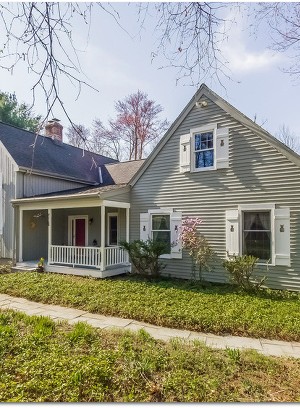
These layout differences are what drive people to gravitate towards a favorite house style. Or they may be showing a preference simply based on their fondness for the type of home they grew up in. Whatever the case, people usually pick a certain house style or two and focus their search on those choices.

We thought it would be interesting to look at home sales in Hartford County and see how they break down by house style. Is there a dominant style that rules the market? (We’re guessing that would be colonials being good ole New England and all) Do some towns have more capes than others? Where can you find the contemporaries? Here’s a look at the data of single family homes that have sold so far this year in Hartford County, broken down by style and town. As always, data comes from the CT Multiple Listing Service and is deemed reliable, but not guaranteed…


House Styles In Hartford County

Surprise, surprise- colonials come in as the most common type of home sold this year (and probably every other year) with 39.5% of the market. Ranches and capes are the next most common home styles.

But what if one wants a less common house style, say a contemporary or bungalow? Where should you focus your search? Well, based on the data provided, Simsbury or Glastonbury would probably be your best bets to find a contemporary and West Hartford and New Britain could score you a bungalow.

We find that most people focus their search on one specific town or a couple of towns. Location seems to trump house type. So, if I want to live in a tudor I’m either going to need to be really flexible on town or aggressively stalk the tudors in my town of choice. A word of advice, if you’re stalking a house try not to alarm the owner or its neighbors…

Do you have a preferred house style? What makes it your favorite?

Hartford County Revaluation Schedule

Last week we gave an overview of the 2011 City of Hartford revaluation. Here’s the revaluation schedule for the rest of the towns in the County.

55 Elm Street in Downtown Hartford2010: none

2011: East Hartford, Enfield, Hartford, Manchester, Marlborough, Newington, Plainville, Southington, West Hartford

2012: Berlin, Bristol, East Windsor, Farmington, Glastonbury, Granby, New Britain, Simsbury, South Windsor

2013: Avon, Burlington, Canton, East Granby, Rocky Hill, Suffield, Wethersfield, Windsor, Windsor Locks

2014: Bloomfield

The process is basically the same everywhere. Towns review all the properties to make sure they have the correct stats – beds, baths, size, etc. Next they gather information on sales and feed all the data into the computer. A value is assigned to each property and the owners are notified – generally in the fall of the revaluation year.

West Hartford has an FAQ document on the part of their website related to the 2011 revaluation. Here is their answer to one important question that homeowners often have.

What will happen to my assessment if I improve my property?

While property improvements generally increase the value to your property, they may or may not change the assessment to your property. For example, while replacing a roof covering, a furnace, a water heater or updating your electrical main should have a positive effect on your market value they are not likely to increase your assessment. Landscaping your property should increase its curb appeal and could also increase its value, but would not increase your assessment. There are also improvements that would increase your market value and correspondingly your assessment. Some of these changes include adding central air conditioning, finishing off a basement, building an addition, and possibly remodeling a kitchen or bath(s).

Even after property owners receive their initial letter, they have an opportunity to challenge the new valuation. It usually begins with an informal hearing, which is basically just a meeting in which the owner can present their case. We always advise bringing data to support your argument. If the informal hearing doesn’t produce the desired outcome, then there is a more formal appeals process. This can vary by town, so be sure to check with your assessor to find out the exact process.

Remodeling Cost versus Value

Major Kitchen RenovationThe November 2009 issue of Remodeling Magazine included the 22nd edition of their annual report about the financial impact of various home improvement projects. They look at both midrange and upscale projects, and hit on all the major renovations, calculating the percentage of the cost that could be recovered in a sale. Data is broken down by region and even by major cities within a region. I was excited to discover that Hartford is one of the cities profiled, meaning that the data is specific to our area. Check out the complete list of projects and paybacks for Greater Hartford on the Cost vs Value Website.

There is lots of interesting data – here are some observations after poking around the various reports:

- Most projects allow homeowners to recoup between 60% and 80% of their cost. Basically this is saying that it is not appropriate to think about renovations as “investments” since they will rarely increase the value of a home by more than the cost of the project. Sellers sometimes think that they should recover at least 100% of the value of recent projects. Every situation is different, so in some cases that may be true, but in general remodeling projects do not “pay for themselves” except when the owner’s enjoyment of the finished work is factored in.

- Most of the projects with higher payback percentages are structural renovations that have little opportunity to customize. For example, siding and window replacements rank highly. On the other hand, projects that are often very specific to the owners bring a lower payback. Examples here include a sunroom addition or a home office renovation.

- At the national level, payback amounts for most projects have decreased since last year. However in the New England region paybacks have actually increased for most projects, though the report doesn’t try to explain why this might be true. Perhaps the data simply reflects the fact that the housing stock in New England is older than in other parts of the country so renovations are more important here.

- Payback amounts are generally higher in the Hartford metro area than in the New England region, which are in turn higher than the national averages. Renovation projects are apparently very cost effective in our area – good news for us! Three projects return an average of more than 100% in Greater Hartford (siding replacement, converting attic space to a bedroom, and replacing the front door).

Check out the full report to see the specifics for any projects that you’re considering. The key message that the study sends is that each dollar spent on the average remodeling project translates into less than a dollar of increased value for your home. That being said, the payback for every project is going to be different. It will be based on the needs of your home and specific decisions made within the project.

« Previous Entries